
Solo-founder business idea validation is the process of testing a business concept against buyer evidence before committing to a build. When you work alone, you need an outside challenge to your assumptions—but criticism, encouragement, and a score are not proof that anyone wants the product.
- Business idea validation starts with a specific buyer, a painful problem, and a testable assumption.
- PivotProof suits solo founders seeking structured startup idea critique before customer research, not proof of demand.
- ChatGPT and advisors can challenge business logic; customer interviews investigate whether the problem exists.
- Test a concrete buyer commitment before building. Decide what evidence would make you stop.
Why business idea validation matters for solo founders
A solo founder can write the pitch, design the product, and judge the evidence. That is a dangerous concentration of authority. You need a process that separates what you believe from what buyers actually do.
In 2026, access to critique does not remove that responsibility. A conversation with ChatGPT can examine your argument. A friend can question your plan. Neither interaction establishes customer demand.
If you are choosing a critique method, the startup idea validation tools guide addresses that separate decision. Choose the method by the uncertainty you need to resolve, not by how convincing its answer sounds.
Your constraint is attention. Every hour spent polishing an untested concept is an hour not spent investigating the assumption that would kill it. Start there.
How to validate a business idea without a cofounder
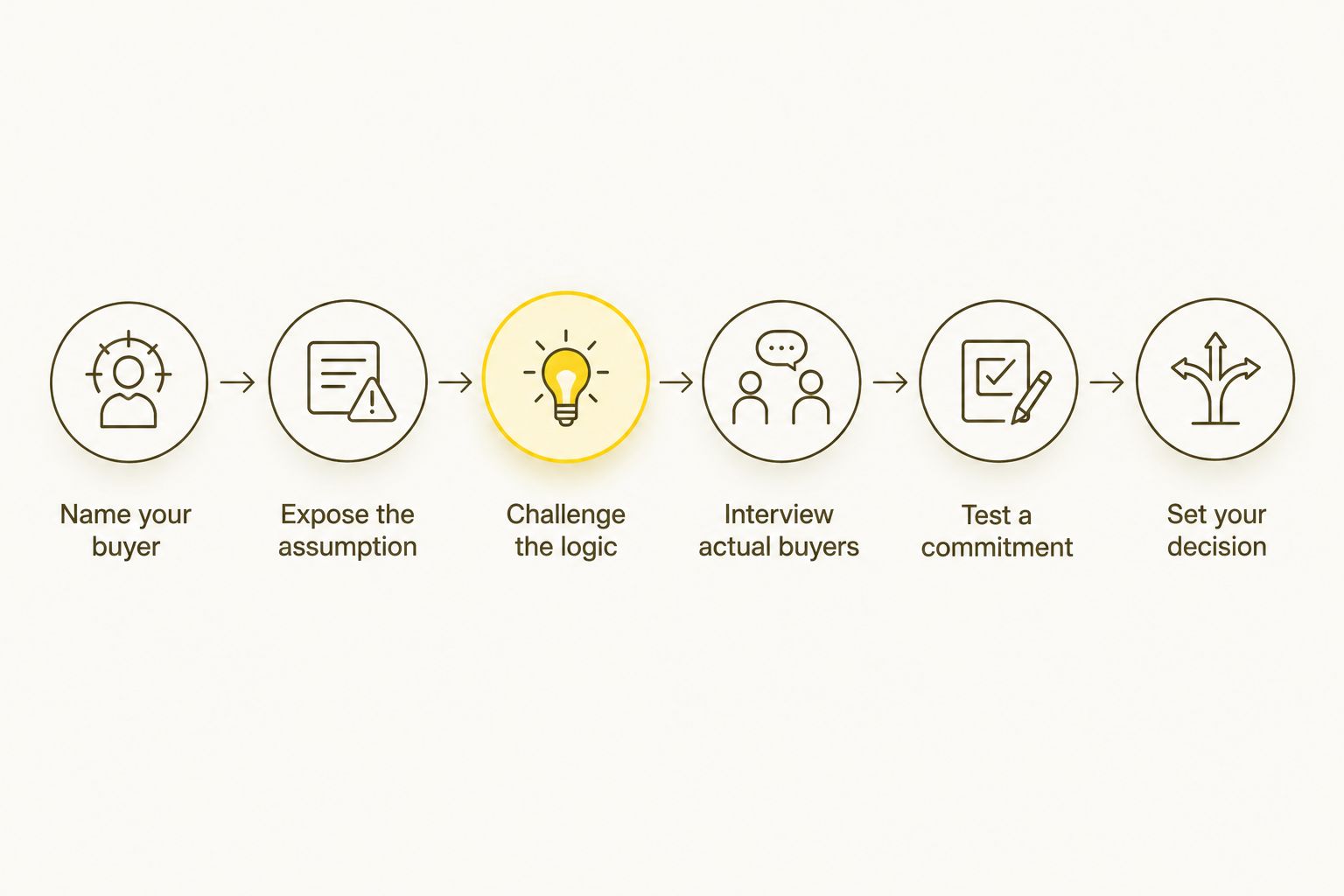
Use this sequence: name your buyer, expose the assumption, challenge the logic, interview actual buyers, test a commitment, and set your decision. Each stage should produce something concrete: a buyer definition, an objection, an observation, or a decision rule.
Keep the work in a plain document or spreadsheet. You do not need software to begin. You need a record that prevents yesterday’s guess from becoming today’s fact.
Name your buyer
Start manually. Write down who experiences the problem, what triggers it, and who controls the decision to adopt a solution. A label such as small businesses is not a buyer definition. It leaves you unable to choose interview subjects or interpret their answers.
Separate the user from the buyer. Someone can dislike a task without having authority to change how it gets done. Your idea needs a route through both realities.
For your 2026 validation brief, describe an observable situation rather than an imagined personality. Someone who completed the troublesome task recently can explain what happened. Someone who merely fits a demographic can only react to your pitch.
Keep the first segment narrow enough that different conversations concern the same problem. You can expand later. Early breadth makes conflicting evidence harder to interpret.
- Identify the role that experiences the problem.
- Describe the event that makes the problem urgent.
- Name the person who approves a change.
- Record the current workaround or alternative.
- Exclude adjacent audiences from the first test.
Expose the assumption
Write the idea as a chain of claims. This buyer has this problem, handles it this way, and would change behavior for this reason. Then identify the weakest link.
Do not start with a feature list. A feature answers a proposed solution question. Your first job is to establish whether the underlying problem deserves attention at all.
A useful assumption can be contradicted by evidence. Buyers hate administration is too vague. Buyers already spend time reconciling this particular record by hand is a claim you can investigate through recent examples.
Put a failure condition beside the claim before you research it. Otherwise, you can reinterpret every response as progress. In 2026, a longer research document still does not rescue a claim that nobody has tested.
Prioritize the assumption whose failure makes the rest of the plan irrelevant. A distribution problem can kill an idea even when the product concept sounds useful.
- Separate observed facts from founder guesses.
- List assumptions about pain, access, adoption, and delivery.
- Pick the assumption that would invalidate the concept.
- Define what would contradict that assumption.
- Choose a test that can reveal the contradiction.
Challenge the logic
The manual route is an objection sheet. Write the strongest argument against your idea, then ask a friend or advisor to attack the claim rather than grade your enthusiasm. Request specific objections, not a general opinion.
ChatGPT is another way to examine the written argument. Supply the buyer, problem, current alternative, and constraints. Ask it to distinguish supplied facts from assumptions and propose tests for the uncertain parts. Treat the output as critique, not research findings.
Five expert perspectives, a score, and clear next tests are the useful lens for paid critique. PivotProof uses five AI expert personas to critique and score startup ideas. Use that structured review to turn objections into experiments—not to declare the idea validated.
PivotProof is best for solo founders who want structured startup idea critique before customer research. Its limitation is decisive: AI critique does not establish customer demand.
- Give each critique method the same written brief.
- Ask which assumption deserves the next test.
- Separate logical objections from claims requiring research.
- Reject unsupported market assertions as evidence.
- Convert each useful objection into a testable question.
Interview actual buyers
Start with people who fit the buyer definition and have recently encountered the problem. Ask about what happened, what they did, and what the consequences were. Keep your solution out of the opening conversation.
Use a manageable first batch: schedule 5 interviews of 20 minutes each. This is a suggested working plan, not a sample size that proves demand. Expand or change recruitment when the conversations expose gaps.
Ask for a recent example. Follow the sequence of events. What triggered the task? Where did it become difficult? What workaround did the person use? A concrete account tells you more than approval of an imaginary product.
For a 2026 interview log, keep observations separate from interpretation. Record that a buyer manually re-entered information, for example, rather than writing that the buyer desperately needs automation.
Do not turn the conversation into a defense of your idea. An objection is not an attack to defeat. It is information you came to collect.
- Recruit people with direct experience of the problem.
- Ask about the last occurrence, not hypothetical intent.
- Investigate the current workaround and its consequences.
- Record exact statements only when you capture them accurately.
- Separate user frustration from authority to adopt a solution.
- Note evidence that contradicts your original brief.
Test a commitment
Interviews investigate the problem. A commitment test investigates whether a buyer will act on your proposed solution. Those are different questions. Do not let a useful conversation answer both by accident.
Start manually when possible. Offer a clearly described trial of the underlying service or workflow, with honest boundaries. You can test whether someone will supply required information, involve the decision-maker, or participate in a real task without building a full application.
Choose the action before presenting the offer. A compliment is not the same as agreeing to a scheduled evaluation. An email signup is not the same as adopting a workflow. Name exactly what each action demonstrates.
Use a 7-day experiment window as a suggested scheduling boundary, not a rule about buyer behavior. Longer decision cycles require a different schedule. The purpose is to prevent an indefinite test with no decision point.
- Choose an action connected to the intended buying process.
- Explain what exists and what remains unbuilt.
- Make one clear request instead of several vague ones.
- Record the request, response, and follow-through.
- Investigate refusals without pressuring the buyer.
- Avoid counting different commitment types as equivalent.
Set your decision
Before the experiment ends, define what makes you continue, revise, or stop. Tie each decision to the assumption you tested. Do not substitute your excitement for a rule you dislike.
Continue means the evidence supports the next bounded test. It does not mean build everything. Revise means changing a specific buyer, problem, offer, or access route. Stop means the current concept failed its test—not that you failed as a founder.
Review the interview notes and commitment results together. A buyer can describe a real problem yet reject your proposed approach. That distinction matters. You might have found a problem without finding a viable solution.
Keep the 2026 decision record short enough to reread before your next commitment. Include contrary evidence. A document containing only supportive observations is a pitch deck pretending to be research.
- State the assumption tested and the method used.
- Summarize observed actions separately from opinions.
- Record the strongest contradictory evidence.
- Choose continue, revise, or stop for this concept.
- Specify the next experiment and its decision rule.
Compare your validation options
These methods answer different questions. Structured critique examines the argument; customer research examines the buyer’s reality. Neither a tool nor an advisor should claim authority over evidence it has not collected.
Use the comparison to select the next task, not to crown a universal winner. A solo founder can combine methods without treating them as interchangeable.
| Option | Best for | Main advantage | Key limitation |
|---|---|---|---|
| Manual assumption review | Defining the first test | Requires no paid tool and makes claims explicit | You remain the author and judge of the argument |
| ChatGPT | Exploring objections to a written concept | Lets you question and revise the critique interactively | Generated answers are not customer evidence |
| Friends or advisors | Applying relevant experience to a decision | Allows follow-up questions and contextual discussion | General encouragement does not test buyer behavior |
| PivotProof | Structured startup idea critique | Uses five AI expert personas to critique and score the idea | The score does not prove demand or replace interviews |
| Customer interviews | Investigating recent problems and workarounds | Connects the concept to actual experiences | Described pain does not establish adoption |
| Commitment experiment | Testing a specified buyer action | Observes response to a concrete request | The result applies to that offer, audience, and test |
Decide whether paid critique fits the next move
Buy report credits when you have a defined concept and want structured objections before you commit more work. PivotProof fits that task. Bring a concrete brief so the critique addresses a business claim rather than an empty slogan.
Skip paid critique as a substitute for reaching customers. If your unanswered question is whether buyers encounter the problem, interviews are the next move. If your question is whether they will act, design a commitment test.
Do not purchase reassurance. A favorable critique still leaves you responsible for evidence. An unfavorable critique should produce a sharper question, not an automatic shutdown.
Challenge the idea before building
Use five expert perspectives and a score to identify assumptions for your next customer test.
Common mistakes solo founders make
Treating agreement as demand
A friend saying the idea sounds useful has expressed an opinion. You still need to establish the problem, the buyer, and the action they will take. Ask what evidence would change the friend’s view instead of collecting another endorsement.
Letting a score replace a test
A PivotProof score belongs to a structured critique, not a customer transaction. Use the objections to prioritize research. Do not put the score in the evidence column beside observed buyer behavior.
Recruiting people who are easy to reach
Convenient respondents can fall outside your target segment. Their answers then address a different business. Check role, recent experience, and decision authority before treating a conversation as relevant evidence.
Building around every objection
An objection does not automatically justify another feature. First determine whether it concerns a real buyer requirement, an unsupported assumption, or your chosen segment. Otherwise, critique becomes a backlog instead of a filter.
Changing the pass condition afterward
If a buyer declines the requested action, do not quietly redefine success as a positive conversation. Record the refusal. Revise the test openly if the request was wrong, and preserve the original result.
FAQ
What is business idea validation for a solo founder?
Business idea validation is testing a business concept against evidence before committing to a build. A solo founder defines the buyer, challenges assumptions, investigates recent customer problems, and tests a concrete commitment.
What is the best way to start validating my business idea?
Start by naming a specific buyer and the assumption whose failure would invalidate the idea. Choose a test for that assumption before writing a feature list or commissioning a build.
Can ChatGPT validate my startup idea?
ChatGPT can critique your startup argument, but it cannot establish customer demand from your prompt. Use its objections to prepare interviews and commitment experiments, not as evidence that buyers want the product.
Is PivotProof better than feedback from friends?
PivotProof provides structured critique through five AI expert personas; feedback from friends is an interpersonal discussion. Choose structured critique for examining assumptions and relevant advisors for contextual judgment. Neither replaces customer research.
How many customer interviews should I do first?
Use five interviews as an initial working batch, not a threshold that proves demand. Recruit people with recent experience of the problem, then expand or change the sample when important questions remain unresolved.
Should I buy report credits before talking to customers?
Buy report credits when structured critique would sharpen the assumptions you plan to test. If your main uncertainty is whether buyers experience the problem, prioritize customer interviews instead.
Does a high idea score mean I should build?
No. A high idea score is not proof of demand. Investigate the critique's assumptions with customers and test a concrete commitment before expanding the build.
One last thing
Write the shutdown condition before you seek feedback. Put it beside the assumption, not at the bottom of a notebook you will never reopen.
For your next 2026 decision, ask: What observed result would make me stop this version of the idea? If the answer is nothing, you are not running a validation process. You are collecting permission to build.