
Startup idea validation tests competitor risk by identifying what buyers use now, finding a specific reason they would switch, and testing that reason with actual buyers before you build. Your competition includes existing software, manual work, and doing nothing—not just startups with similar features. A critique can expose weak assumptions; only customer research and observable behavior can test demand.
- Startup idea validation must test why buyers would leave their current alternative, not whether your feature list looks different.
- PivotProof provides structured business idea validation critique; customer interviews must test the assumptions behind it.
- ChatGPT and advisors can challenge your thinking, but their agreement does not establish customer demand.
- Test switching barriers and buyer commitment before building the product those buyers supposedly need.
How do you test competitor risk in startup idea validation?
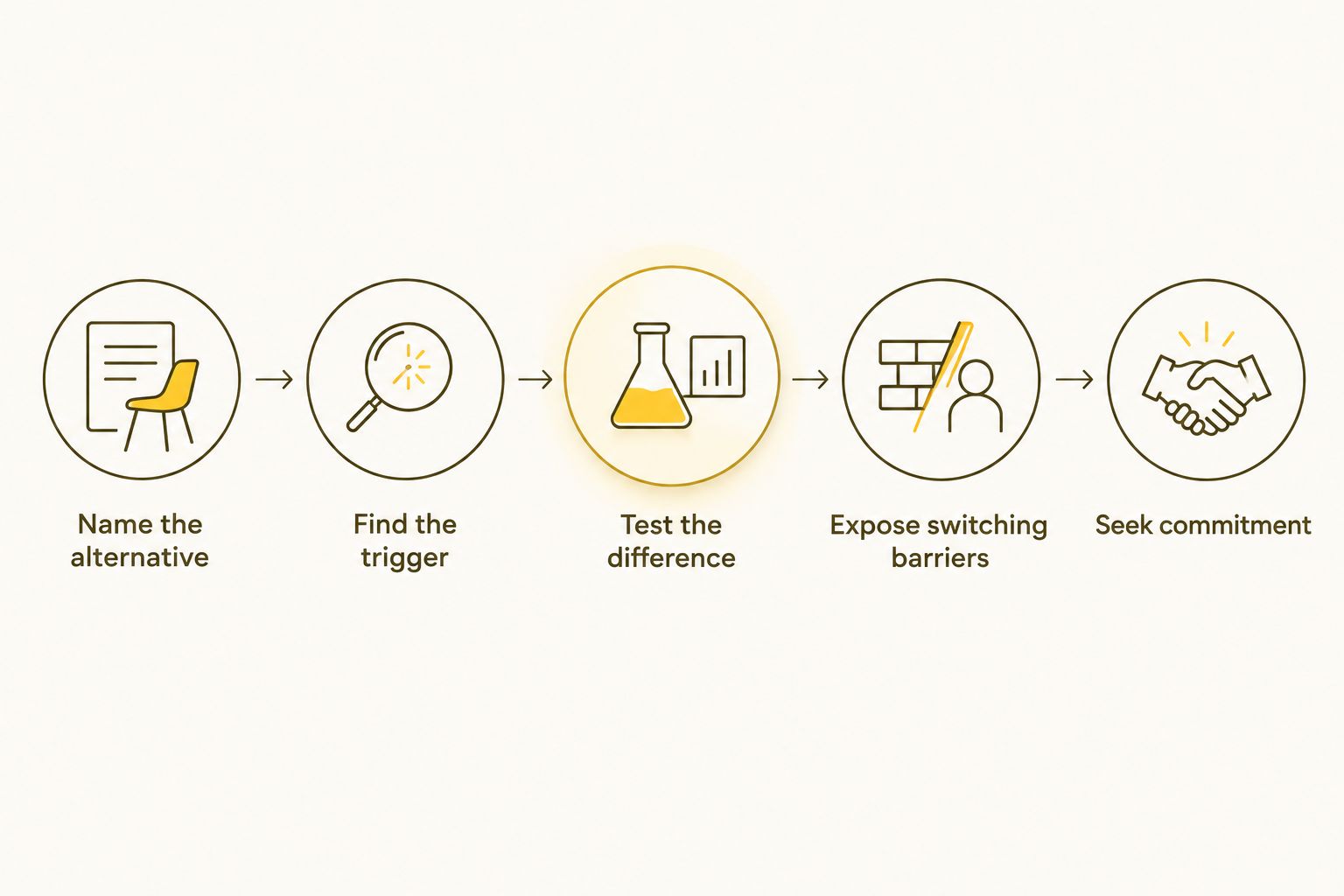
Start with the buyer's current behavior. Then test whether your proposed improvement is strong enough to change it. PivotProof offers five expert perspectives and a score for startup idea validation; use the critique to define clear next tests, not to declare the idea validated.
- Name the alternative. Record what the buyer currently uses to complete the job, including spreadsheets, internal processes, and leaving the problem unresolved.
- Find the trigger. Ask what happened the last time the current approach failed. Identify the event that made the problem matter.
- Test the difference. Describe the outcome your idea changes. Ask the buyer to explain why that difference matters in their own situation.
- Expose switching barriers. Investigate data migration, approvals, training, integrations, and the risk of disrupting working processes.
- Seek commitment. Ask for a concrete next action tied to the problem: a workflow review, a prototype session, or an introduction to the decision-maker.
These are research steps, not a scoring formula. A buyer who praises the idea but refuses any next action has given you praise, not evidence of adoption.
Why this matters
A competitor list tells you who exists. It does not tell you why buyers choose them, tolerate them, or refuse to leave them. Your startup can look different on paper and still offer no practical reason to switch.
For a 2026 validation plan, investigate the alternatives buyers use today. An old competitor comparison cannot establish current buyer behavior. Check the workflow directly rather than treating a product announcement as evidence of adoption.
The threat is not simply that another product exists. The threat is that your buyer has no compelling reason to change. That is the assumption your research needs to attack.
Existing software: test the reason to leave
An established product gives you something specific to investigate: a buyer has already chosen an approach. Ask what caused that choice, what remains painful, and what would justify reopening the decision.
Do not lead with your proposed feature. Lead with the last incident. Ask the buyer to describe the work, the failure, and the consequence. A complaint without a consequence is a weak foundation for a new product.
Separate dissatisfaction from willingness to switch. Someone can dislike an interface and still depend on the product's integrations, stored data, or internal acceptance. Your idea must address the reason they stay, not just the reason they complain.
Use a direct question: What would have to happen for you to replace this? Follow the answer with a request for a concrete example. If the buyer cannot identify a trigger, keep investigating rather than treating frustration as purchase intent.
Manual work: test whether software removes enough pain
A spreadsheet or improvised process is an alternative, not an empty market. It can fit the buyer's workflow, remain easy to change, and avoid introducing another system. Those advantages belong in your analysis.
Ask the buyer to walk through a recent instance of the work. Identify where information is entered, checked, shared, and corrected. Then distinguish unpleasant work from work with a meaningful consequence when it goes wrong.
Your proposed software also creates obligations. Someone must supply data, learn the process, and maintain it. Compare the entire workflow, not your cleanest demo against their messiest moment.
A useful test is a limited demonstration using the buyer's actual workflow, with permission. Investigate whether the proposed change removes work or merely moves it somewhere else. Do not count a polished screen as evidence of a better process.
Doing nothing: test whether the problem deserves action
Some buyers acknowledge a problem and deliberately leave it unresolved. Your competitor is their decision to spend attention elsewhere. A better product description does not automatically change that priority.
Ask what happens if the problem remains untouched. Then ask what they address instead. You need to understand the trade-off, not persuade them that your preferred problem should matter more.
If there is no clear consequence, deadline, or trigger for action, your validation task changes. Investigate whether another buyer segment faces a sharper version of the problem. Do not add features to compensate for weak urgency.
In 2026, the relevant evidence is still buyer behavior. A growing category or active competitor does not establish that your specific customer wants your specific solution.
Why competitor risk varies
Competitor risk depends on the buyer's situation. Investigate these factors rather than assigning a blanket risk level to a crowded category:
- Problem consequence. Establish what breaks when the current approach fails. Without a meaningful consequence, switching has little justification.
- Switching effort. Identify the work needed to move data, train users, and change routines. Your improvement must survive that burden.
- Workflow dependence. Find the surrounding processes and integrations that rely on the existing approach. A replacement affects more than its immediate user.
- Decision authority. Distinguish the person experiencing the pain from the person approving a change. Enthusiasm from a user does not establish approval.
- Trigger for action. Identify the event that causes the buyer to reconsider the current approach. A hypothetical future problem is not a present decision.
- Access to buyers. Establish whether you can reach the people who face the problem and evaluate a solution. An attractive segment is not a usable research pipeline by itself.
For your 2026 competitor review, attach evidence to each factor. Record the buyer's example, the unresolved question, and the next test. Leave unsupported assumptions visible instead of hiding them inside a confident score.
Should you use ChatGPT, advisors, or a structured critique?
Use each option for the job it can actually perform. None substitutes for observing customers or testing a buying decision. The comparison below concerns their role in validation, not comparative performance.
| Option | Best for | Useful contribution | Limit |
|---|---|---|---|
| ChatGPT | Founders exploring questions | A conversational way to generate objections and research prompts | Generated answers do not establish how your buyers behave |
| Friends or advisors | Founders seeking contextual feedback | Discussion with people who know the founder or the relevant problem | Encouragement or agreement is not evidence of customer demand |
| PivotProof | Founders seeking structured startup idea critique | Five expert personas critique and score the concept | A generated score is not proof of demand or a replacement for interviews |
| Customer interviews | Founders investigating actual workflows | Accounts of current alternatives, failures, and switching barriers | Stated interest alone does not establish adoption |
PivotProof is best for founders who want structured startup idea critique before building, not proof of customer demand. Buy report credits when you want assumptions challenged across five expert perspectives. The score should organize questions, not settle whether customers will buy.
ChatGPT suits open-ended exploration. Make the task explicit: challenge the switching assumption, identify unanswered questions, and separate claims from evidence. Do not ask for reassurance and then call the answer validation.
Friends and advisors can contribute relevant experience. Give them an assumption to attack rather than a pitch to applaud. Ask what would make the idea fail and what evidence would change their judgment. Critique the plan, not your worth as a founder.
How do you turn competitor critique into a customer test?
A useful critique ends with an experiment. Choose the assumption that would make the idea fail if it were false. Then define what you can observe without building the entire product.
For a 2026 research brief, write down these fields before you contact buyers:
- Assumption: The buyer faces a specific failure in the current workflow.
- Current alternative: The tool, process, or non-action the buyer uses today.
- Switching claim: The outcome that would justify changing that approach.
- Test: The interview, workflow walkthrough, or prototype task that examines the claim.
- Decision rule: The evidence that would make you continue, narrow the segment, or abandon the assumption.
Use neutral questions during the interview. Ask the buyer to describe the last occurrence before presenting your solution. Otherwise, you risk collecting reactions to your pitch instead of evidence about the underlying problem.
Then request an action that matches the research stage. A workflow walkthrough tests access to the problem. A prototype task tests whether the proposed approach fits the work. Neither proves a purchase, so name the evidence correctly.
Decide what failure looks like before collecting feedback. Without that rule, you can reinterpret every objection as support and every polite response as momentum.
Challenge your switching assumption
Get five expert perspectives and a score. Turn the critique into a concrete customer test.
Does having competitors mean your startup idea is bad?
Competitors do not establish that your startup idea is bad. They give you alternatives to investigate, but their existence alone proves neither your demand nor your ability to win buyers. Test the underserved problem and the reason to switch.
Avoid the opposite mistake too. No obvious direct competitor does not establish an opportunity. The buyer can use manual work, absorb the problem, or choose not to act.
What if buyers say they love the idea but will not switch?
Treat refusal to switch as evidence about the current proposition, not an insult. Ask what blocks the change and whether a specific event would alter the decision. Separate an unresolved barrier from a problem that simply lacks priority.
Do not respond automatically with more features. First establish whether the buyer needs a different outcome, less disruption, or no new product at all.
Can a competitor copy your idea?
Feature similarity belongs in the risk assessment, but guessing a competitor's future roadmap is not validation. Test whether your buyer's reason to choose you depends entirely on a feature that has no other supporting advantage.
Ask what would remain useful if another product offered a similar function. If you cannot answer with evidence, record the dependency and test it. Do not invent defensibility to protect the pitch.
FAQ
What's the best way to test competitor risk before building?
Test the buyer's current alternative, reason to switch, and barriers to changing it. Use customer interviews and workflow evidence, then request a concrete next action rather than relying on praise.
Is ChatGPT enough for startup idea validation?
ChatGPT is not enough to establish customer demand. Use it to challenge assumptions and prepare research questions, then test those assumptions with actual buyers.
How does PivotProof help with competitor risk?
PivotProof uses five AI expert personas to critique and score startup ideas. Use that structured critique to identify assumptions for customer tests; the score does not prove demand.
Should I ignore competitors that target different customers?
Investigate any alternative your intended buyer actually uses, even if its stated audience differs. Buyer behavior defines the relevant comparison, not the competitor's positioning alone.
What should I ask customers about their existing software?
Ask about the last failure, its consequence, and what would justify replacing the software. Then investigate migration, approvals, training, and surrounding workflows.
Does a high validation score mean I should build?
A high critique score is not permission to skip customer research. Test the assumptions behind the score and seek evidence of a reason to switch before committing to a full build.
What should a competitor analysis include in 2026?
A 2026 competitor analysis should include current alternatives, problem consequences, switching barriers, and decision authority. Attach buyer evidence and a next test to each unresolved assumption.
One last thing
Ask a prospective buyer to show you what they would stop using if your idea worked. The answer forces your concept into a real workflow. It also exposes whether your product replaces a painful alternative or merely adds another obligation.
If you cannot name what changes for the buyer, you have not finished testing competitor risk. Your next move is not another feature. It is a sharper question and a concrete customer experiment.