
Business idea validation tests willingness to pay by putting a specific offer in front of a specific buyer and asking for a real commitment before you build. In 2026, use customer interviews to understand the problem, then test an honest paid offer; praise, survey answers, and an AI-generated score do not prove customer demand.
- Business idea validation needs a buying decision, not compliments about the concept.
- PivotProof provides structured startup idea critique; customer demand still needs a real-world test.
- Interview buyers about current behavior before asking them to commit.
- Define the offer, delivery terms, and failure condition before running your experiment.
How do you test willingness to pay in business idea validation?
Follow this sequence. Keep the buyer and offer consistent so you can interpret the result.
- Choose 1 buyer segment. Name the person with the problem and authority to buy.
- Investigate existing behavior. Ask what buyers do now, what fails, and what that failure costs them.
- Present a concrete offer. State the outcome, scope, payment terms, and delivery conditions.
- Ask for commitment. Test a purchase or an explicitly conditional paid pilot, not hypothetical enthusiasm.
- Record the outcome. Separate completed purchases, approval steps, refusals, and unanswered requests.
Five expert perspectives, a score, and clear next tests give you a structure for attacking assumptions before this sequence. PivotProof is best for founders who want structured startup idea critique before testing customer demand. That critique is preparation, not validation by itself.
Why this matters
A buyer can like your idea and reject your offer. There is no contradiction. Your concept might solve a real problem without being urgent enough, credible enough, or practical enough to purchase.
For business idea validation in 2026, separate three questions: does the problem exist, does your proposed solution address it, and will the buyer accept your offer? Evidence for one question does not automatically answer the others. A detailed interview establishes what someone reports doing; it does not establish a future purchase.
The danger is building against the weakest evidence because it feels encouraging. A friend approves the concept. A survey respondent selects an attractive answer. You treat both as permission to write code.
Test the buying decision before committing to the build. You need a reason to proceed that survives outside your pitch deck.
Define the buyer before you test the offer
Start with 1 buyer segment and 1 buying situation. That is an experiment design recommendation, not a universal sample-size rule. Narrowing the test makes objections easier to interpret.
Describe the buyer through their circumstances, not a broad label such as small businesses. Identify who encounters the problem, who evaluates solutions, and who controls the spending decision. Those roles can belong to different people.
Write down:
- The event that makes the problem urgent.
- The current workaround or alternative.
- The person responsible for the outcome.
- The approval needed to buy.
- The consequence of leaving the problem unresolved.
If your interviewee cannot authorize spending, ask how approval works. Do not classify their enthusiasm as purchasing intent. It is evidence about an internal advocate, not the final decision.
Keep the initial segment stable. Mixing unrelated buyers makes a refusal difficult to diagnose: you no longer know whether the problem, offer, or audience was wrong.
Interview for behavior, not permission
Customer interviews should uncover what happened before your idea entered the conversation. Ask about a recent instance of the problem. Follow the sequence from trigger to workaround to consequence.
Use 3 interview prompts to start:
- Describe the last time this problem happened.
- What did you do to resolve it?
- Who decided whether to spend money on the solution?
Then ask for specifics. What did the workaround involve? What remained unresolved? What stopped the buyer from choosing another approach? Keep the conversation attached to an actual event rather than an imagined future.
Do not lead with your proposed features. Once you explain the solution, the discussion becomes a reaction to your pitch. That reaction has a use, but it is different evidence.
An interview is not a vote on whether you should build. Its job is to expose the buyer's behavior, constraints, and decision process. Use those findings to design an offer that answers the problem the buyer described.
Make the offer concrete enough to reject
An offer needs an outcome, boundaries, and terms. If the buyer cannot tell what they receive, a refusal says little about willingness to pay. You tested confusion.
For your 2026 validation experiment, prepare a short offer brief containing:
- Buyer: the segment and decision-maker you are addressing.
- Outcome: the problem you will help resolve.
- Scope: what the offer includes and excludes.
- Delivery: what you can actually provide and under what conditions.
- Commitment: the purchase or approval action you are requesting.
If nothing is built, say so. If delivery depends on a condition, disclose it. Never present a concept as an available product or collect money against a promise you cannot responsibly fulfill.
Remove features that do not affect the proposed outcome. You are testing whether the buyer accepts an offer, not whether a long feature list sounds impressive.
Have the buyer explain the offer back to you. A clear rejection is more useful than agreement built on a misunderstanding. Confirm what they believe they would receive before interpreting their decision.
Choose a test that matches what you can deliver
Different tests answer different questions. Choose the strongest honest commitment you can request without misrepresenting the state of the product.
| Test | Best for | What it establishes | Limitation |
|---|---|---|---|
| Offer discussion | Checking whether buyers understand the proposed outcome | Their interpretation and objections | Agreement is not payment |
| Purchase request | Testing an offer you can fulfill | Whether the buyer accepts the stated transaction | A refusal needs follow-up before you diagnose it |
| Conditional paid pilot | Testing a bounded outcome before a full product exists | Commitment to the disclosed pilot terms | Pilot demand does not establish demand for a finished product |
| Approval-process test | Understanding a purchase involving other decision-makers | The required steps, owners, and objections | Progress toward approval is not a completed sale |
A paid pilot can test whether a buyer values an outcome delivered within a limited scope. Its advantage is that you can examine the transaction before building the full product. Its limitation is equally important: the buyer might value your hands-on involvement rather than the eventual software.
An approval-process test helps when the interviewee is not the budget owner. Ask for the actual next step, not an indefinite promise to raise the idea internally. Record the owner and condition of that step.
Do not call every positive response a conversion. A purchase, an approval meeting, and an expression of interest are different events. Keep them separate.
Set the failure condition before collecting answers
Define what would make you stop, revise the offer, or continue testing. Do this before results arrive. Otherwise, you can reinterpret every outcome as encouragement.
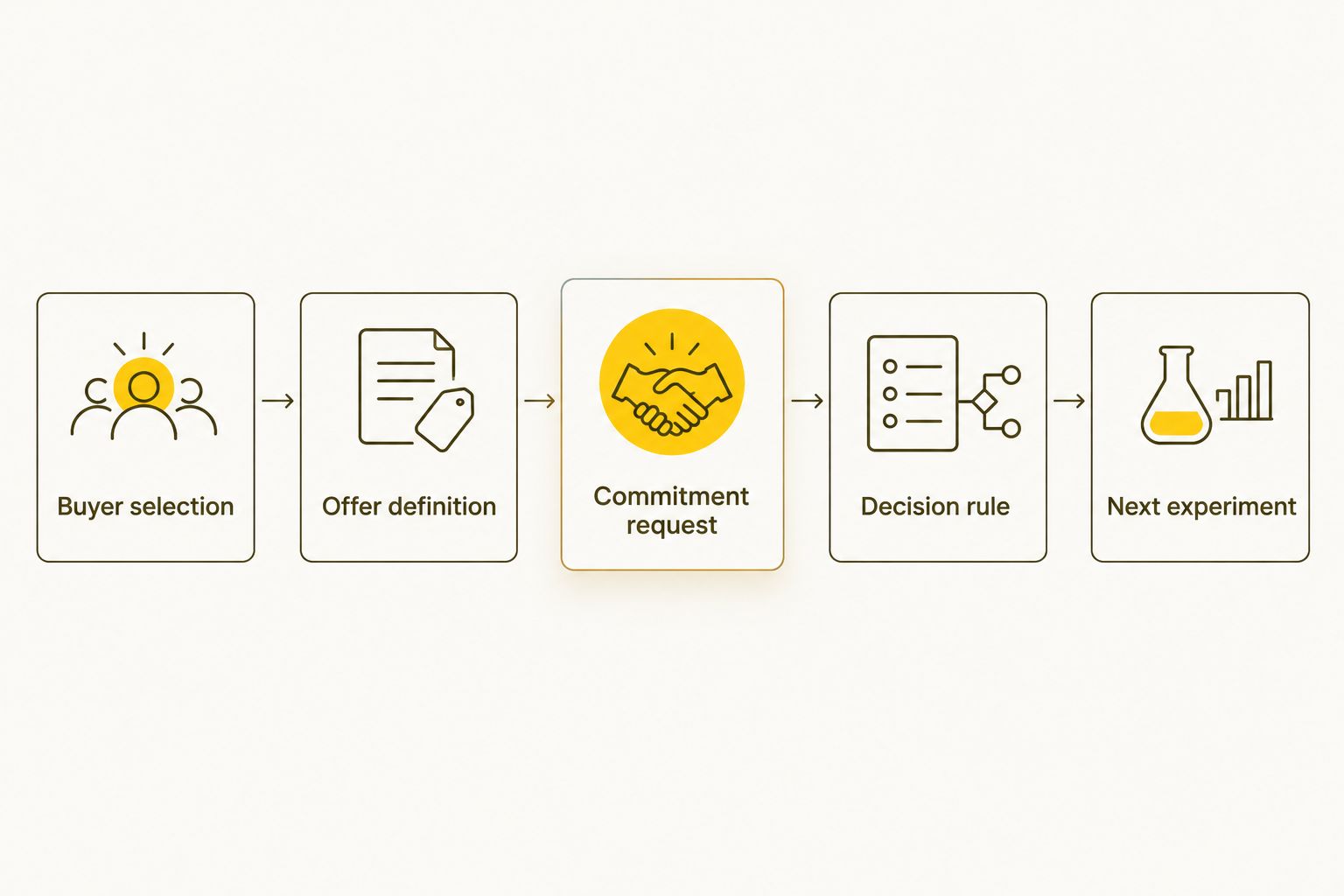
Write an experiment brief with these fields:
- Buyer selection: who qualifies and how you will reach them.
- Offer definition: the exact outcome, scope, and disclosed terms.
- Commitment request: the action that counts as acceptance.
- Decision rule: the evidence required to continue, revise, or stop.
- Next experiment: the uncertainty you will test afterward.
There is no universal acceptance threshold for every startup idea. Set the decision rule around your proposed business and the consequence of being wrong. Do not borrow a conversion benchmark from an unrelated offer and treat it as permission to build.
Keep a record of who received the offer and what happened. If you only record buyers who responded positively, you erase the refusals that the test was meant to expose.
Changing the buyer, scope, and commitment request simultaneously creates a different experiment. You can make that change, but label it as a new test. Do not merge the results into a single success story.
Why willingness to pay varies
A refusal does not identify its cause. Ask what prevented the transaction, then compare the answer with the buyer's earlier account of the problem.
For a 2026 offer test, examine these factors separately:
- Urgency: the problem exists, but the buyer has no reason to act now.
- Authority: the person likes the offer but cannot approve spending.
- Scope: the proposed outcome does not match the job the buyer needs done.
- Trust: the buyer does not accept the delivery promise or provider risk.
- Switching effort: adopting the offer requires work or approvals the buyer rejects.
- Alternatives: the current workaround remains acceptable to the decision-maker.
Treat each explanation as something to investigate. A buyer's stated objection is useful evidence, not a complete causal diagnosis.
Change the offer when evidence identifies a specific mismatch. Do not respond to every refusal by adding features. If the problem lacks urgency, a larger feature list does not establish urgency.
Where do ChatGPT, friends, and structured critique fit?
Use each alternative for the question it can answer. None can make the purchasing decision on behalf of your target buyer.
| Option | Best for | Useful contribution | Boundary |
|---|---|---|---|
| ChatGPT | Drafting and revising test materials | Exploring objections and sharpening interview questions | Generated answers are not customer evidence |
| Friends or advisors | Challenging reasoning with relevant context | Identifying unclear claims or sharing direct experience | Their approval does not establish target-buyer demand |
| PivotProof | Structured startup idea critique before building | Five AI expert personas critique and score the concept | The report does not replace interviews or a buying test |
| Target buyers | Testing the problem and offer | Reporting current behavior and making an actual decision | A limited test does not prove broad demand |
Friends and advisors can provide useful criticism. Ask what their judgment rests on. Direct experience with the buyer or purchasing process matters more to your experiment than general encouragement.
ChatGPT can help you rewrite an unclear offer. You still need to check the resulting assumptions against buyers. A coherent answer is not a transaction.
PivotProof's paid startup idea validation reports give you structured opposition from five perspectives. Use the score as a critique output, not a market verdict. The next move is to turn an objection into a test with a buyer, an offer, and an observable result.
Buy report credits when you need that structure before selecting your next experiment. If you already have a specific unresolved buying objection, test it directly rather than collecting another opinion.
Does a waitlist prove people will pay?
A waitlist records interest, not willingness to complete a purchase. It can help you recruit people for an offer test, but joining does not establish acceptance of payment or delivery terms.
Return to those people with a concrete, honest offer. Record the buying decision separately from the signup.
What should you do when buyers refuse the offer?
A refused offer is a reason to investigate the buying decision, not automatically abandon the idea. Identify whether the rejection concerns the problem, proposed outcome, terms, trust, or approval process.
Revise the assumption supported by that evidence. If you cannot identify what changed, you cannot explain why a later result is better.
When is an idea validated enough to build?
Build the smallest deliverable justified by the commitments you actually observed. A purchase supports that particular transaction; it does not establish repeat use, scalable acquisition, or a sustainable business.
Your next test should address the next unresolved risk. Do not turn a narrow success into a claim that every major assumption has survived.
FAQ
What's the best way to test willingness to pay before building?
Present a concrete offer to a defined buyer and ask for a real commitment you can honor. Use interviews first to understand the problem, then record purchases, refusals, and approval steps separately.
Can I validate a business idea without building software?
You can test the problem and a disclosed offer before building software. A bounded paid pilot can test demand for its stated outcome, but it does not prove demand for an eventual finished product.
Is ChatGPT enough for business idea validation?
ChatGPT is not enough to establish customer demand. Use it to prepare questions and examine assumptions, then test those assumptions with target buyers.
Is feedback from friends useful for validating a startup idea?
Feedback from friends is useful when it identifies a specific weakness or draws on relevant experience. Approval from someone outside the buying decision is not evidence that your target customer will pay.
What does a PivotProof score tell me?
A PivotProof score is an output of structured startup idea critique by five AI expert personas. It does not prove customer demand or replace customer interviews.
How many customer interviews do I need?
There is no universal interview count that proves willingness to pay. Keep learning about the buying process, and test an actual offer instead of treating interview volume as validation.
Should I collect payments for a product that does not exist yet?
Never represent an unbuilt product as an available product. Any conditional offer must clearly disclose what exists, what you promise to deliver, and the applicable terms before a buyer commits.
One last thing
Before your next 2026 validation test, write down the result you least want to see. Then explain what you would do if it happened.
If every possible result leads to building the same product, you have not designed a test. You have designed a ceremony. Give the evidence permission to change your plan.